‏הצגת רשומות עם תוויות history. הצג את כל הרשומות

יום שלישי, 14 בפברואר 2017

Victorian Floral Code


Dating and courtship in the age of emojis and Tinder can absolutely be a nightmare. But imagine how life must have been for the victorians, when members of the respectable classes couldn't even ask out the object of their desire for a cup of coffee. Instead, the hopeful victorian suitor had to resort to a very specific code to win over his lady love- The language of flowers.


Victorian courtship. Let's hope he means true love...


The vicotorian era in England (between 1837 and 1901), named after the British queen Victoria, is widely associated with social cruelty, heavy industry and inhumane neglect of the working classes; greatly due to the novels or Charles Dicknes. But more than anything, it seems to have been an era of what today would be considered mind- boggling hypocrisy on the part of the upper and aristocratic classes: On the one hand, words like "chest" or even "limbs" would never have come up in a polite drawing room conversation. On the other hand, orgies became a favorite pastime and prostitution rates are still among the highest in recorded history.


It's not surprising therefore, that courtship also had to be conducted under strict regulations. After all, a young man from a respectable family couldn't exactly walk up to the girl of his dreams and say "hi". Instead, he had to make his intentions clear by using a type of victorian "Mors Code"- a bouquet of flowers. Flowers were such a staple of communication between the sexes that each flower had a widely understood meaning of its own, so a successfully put together bouquet could represent an entire "pick up" line. One combination of flowers could mean "your eyes mesmerize me", while another could say "sorry, I'm married." In an attempt to help the confused suitor send his lady the right message and keep him from making a colossal mess of it, flower dictionaries were published by the thousands during that period, detailing the secret meaning of each flower.


The Victorian "Language of Flowers" dictionary- a must-have for any hopeful suitor.


The dictionaries offered a coherent glossory of all available flower types and their acceptable social meaning. For instance: Bluebells meant that he admired your kindness; violets meant that your humble nature and humility were really turning him on; tulips were often used to say that he liked you; Jasmin said "you are charming"; while red roses were a clear sign that, well... he's itching for you in a body part that he dare not speak of.


Judging by the flowers on her end table, that is one steamy letter that she'd received...

"The Love Letter"/Auguste Toulmouche. 1883


But not all roses smell as sweet, and not every flower was a declareation of fondness. Yes, dear maiden, if you received chrystanthemums, he was telling you "let's be friends". If he sent you cyclaments, he was trying to break up with you; and if he was so rude as to send you orange lilies, he purely hated you! (as opposed to white lilies which meant that you are a rare beauty- what a difference a shade makes!) You can definitely say that flowers were the emojies of the 19th century.


Orange and white lilies: Someone's sending mixed messages!


But the one who transformed the victorian floral code into a truly sexy phenomenon was French novelist Alexander Dumas fils ("junior") with his renowned novel "The Lady with the Camellias" (La Dame aux Camellias). In 1848, Dumas junior- son of the man who introduced the world to "The Three Musketeers", published his sensual novel, the main character in which is a courtesan (basically a high-end escort for the aristocracy) named Marguerite Gautier who carried a bouquet of camellias wherever she went. Since camellias were known to be the sign for flirtation, Marguerite's bouguet was her way of saying "How you doin'?" to every wealthy gentelmen who crossed her path.


Rumer had it that Marguerite's character was actually based on a real life courtesan- a woman named Marie Duplessis who was very famous in the Parisian upper class circles, and who was said to have been the mistress of the author himself. 
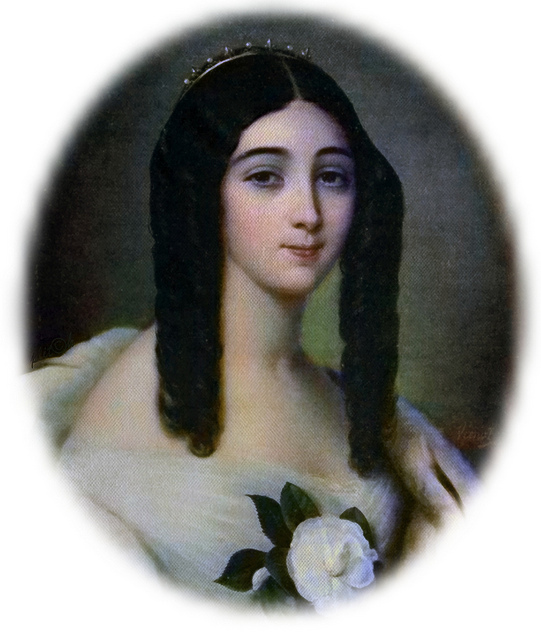


Portrait of Marie Duplessis- the woman, the mistress and the inpiration for "The Lady with the Camellias"


Even though the French were much more liberal than the British when it came to expressing their emotions and secret urges (they were French, after all), the heroine of the novel was still constrained by social conventions, and so she only had her camellias as a business card for attracting potential customers. An amazing example of that can be seen in the first chapter of the novel, where she is described carrying her bouquet of white camellias as she  attented the opera every night (the place where the creme de la creme of society would go to see and be seen). But then it goes on to say that for about three or four days out of the month, Marguerite would appear at the opera house carrying red camellias instead. A clever way of telling you're stuffy aristocratic clients that you are...shall we say "closed for business."


Unfortunately,  Alexander Dumas junior was a typical 19th century man. And as such, he couldn't allow this sinner of a woman to have her happy ending. So the novel ends with Marguerite's tragic deeath as a result of consumption (and according to some critics, that may have been a euphemism for a sexually transmitted disease). Nevertheless, the passion and rebellious nature of the novel made it so popular that in 1853 Italian composer Giuseppe Verdi adapted it to his famous opera "La Traviata" (literally: "Fallen woman" in Italian), and in 1915 it became a widely successful silent film titled "Cameille". The film itself was remade in 1936 with Greta Garbo starring in the role of Marguerite Gautier; a role which earned her an Oscar.


Greta Garbo as Marguerite. 1936.


Modern day Marguerite: On the left- the cover of Aleander Dumas' classic novel. On the right- a model wearing Dolce & Gabbana's "Rose Dress" in their fall/winter 2016 show.

So on this Valentine's day when you want to convey a message to that special someone or if you are just fed up with deciphering winking smiley faces in a text message, why don't you pay a visit to your neighborhood florist and try to find a flower that says: "Want to go for a drink?"

יום ראשון, 24 ביולי 2016

Killer Queen: Historic Queens who Dressed for Death


Anyone following this blog knows by now that there's nothing I love more than the fashion statements made by historic ladies, particularly of the regal kind. In a post I published some time ago in the blog "Francophiles Anonymous", I discussed the fashion revolution lead by the legendary French queen Marrie Antoinette (The linked post has not been translated to English yet). But believe it or not, history is filled with great queens who actually stopped to consider the color and shape of their dress even in the face of death. 
One such queen was the second wife of Henry the VIII of England (aka: The worst husband in history), Anne Boleyn, who met her tragic death by execution on the 19th of May 1536, at the age of 35.  


Oil on canvas portrait of Anne Boleyn. From Hever castle.


Anne Boleyn was executed on charges of fornication and betrayal. But she knew all too well that those charges were only an excuse to remove her from the king's life, simply because much like her predecessor, Catherine of Aragon, she too failed to give the king a son. Divorce would have meant that the king would be obliged to pay the Boleyn family some amount of money or property. But if a queen (much like any other woman of means in the 16th century) died, then all her wealth and property would have gone to her husband. How convenient... 
And so, on that fatal morning, Anne Boleyn climbed the steps to the gallows wearing a classically English "Gable" shaped hood, a cape trimmed with weasel fur and a crimson colored skirt. And if you think that she wore that outfit simply because it was the only thing she had with her in the Tower of London, then you underestimate the woman who had sonnets written in honor of the way she wore her green sleeved gown.


Like many wearlthy aristorcratic parents of the Tudor era, Anne's parents sent her to be raised and educated in the French court as part of the French Queen's  entourage (sort of like the rich and privilaged young women of today who get a job at "Vogue" through their parents connections and worship at the altar of Anna Wintour). So by the time Anne came back to the English court, she brought with her all the fahsion and glamour of 16th century Paris and stood out like a rose among thorns.  For example, while most women at the English court covered their heads with heavy, awkward looking gable shaped hoods (imagine walking aroung with a slated roof on your head...); sexy Anne flaunted her shiney black tresses by wearing a small rounded and pulled back French hood, which she famously decorated with pearls.


If you got it, flaunt it! Natalie Dormer as Anne Boleyn in her French hood ("The Tudors")


Yet on the morning of her execution Anne stepped out wearing the traditional English hood in an attempt to make people forget about all the French influences she brought with her to England, and to send the message that she was always loyal to England and the head of its state and church- the king. The weasel fur trim was also a deliberate fashion choice: the only people who could afford to wear such an oppulant fur at that time were members of the aristocracy. So by choosing to wear it, she was actually saying "you are killing a woman of noble blood, you assholes!" Imagine going to the electric chair carrying a limited edition Chanel bag.  And that is what I call making a stylish exit! 


Execution Chique: Natalie Portman as Anne Boleyn in "The Other Boleyn Girl"


Even her crimson colored skirt was a deliberate choice, since according to the Anglican Church, which Anne helped establish during the king's break from the Catholic Church; crimson was cosidered to be the color of holy martyrs. By choosing to wear this color Anne was making a statement that wasn't lost on any follower of the newly founded church: that she was innocent of all the charges brought against her, and that by executing her the king and his councillors were actually making her a martyr. Well, Anne may not have gone down in Anglican history as a martyr, but history does remember her as the senseual and higly ambitious woman who made a king divorce his queen and abandon his religon. Not bad for a girl in weasel fur and a triangle shaped hood. 


About two hundred years after Anne Boleyne, on the eastern side of the continent, a different queen stopped to have her hair done on her way to a military coup she had organized in an attempted to overthrow her husband. Her name was Catherine the Great- Empress of Russia. 


Empress Catherine the Great as a young girl 


Catherine (or Yekaterina as it is pronounced in Russian) was born Sophia Friederika Augusta in the small Prussian principality of Anhalt-Zerbst (today a part of Poland). Much like her French counterpart Marrie Antoinette, she too traveled from a smaller provincial kingdome to a glamorous big city as a naive fifteen year-old girl to marry an infantile man-child who cared more about his board game soldiers than he did about his wife. But unlike Marrie Antoinette, little sophia didn't arrive at a chique and sophisticated court like Versailles, but rather to a primitive Russian palace swarming with vodka guzzling soldiers.


Nonetheless, the young princess was quick to realize that there's no use relying on her immature husband Peter ("Pyotor") the III, and she set her sights on a much better allay- Peter's aunt and legal guardian, the Grand Empress Elizabeth ("Yelizaveta"). The first step in getting on Elizabeth's good side was for Sophia to convert from her own Lutheran religion to the Provo Slav- Orthodox religion prevalant in the Russian empire and devoutly practiced by Elizabeth. Sophia even went as far as abandoning her birth name and taking on the name of Empress Elizabeth's late mother- Catherine. 

Think about that the next time you only get your mother-in-law a salad bowl for the holidays!


Tragically, Empress Elizabeth died on Chirstmas Eve 1761, and the following year Catherine's husband was crowned Czar of all Russia. This meant trouble for our Catya, because Peter saw this as the perfect opportunity to get rid of his wife, who proved much more educated than him and way more popular with the other courtiers. 
And so, in June of 1762, he banished her to the Peterhof Palace (if you can call being forced to stay at a lavish palace with gilded dance halls and vast gardens "banishment"...) and later planned to have her shipped off to some rinky-dink monastery for the rest of her life. 


But as always, Catherine knew how to find friends who would come to her rescue. And let's just say she was never one to sit and wait for her husband to provide her with some nighttime pleasure (or to father her children for that matter...). So in a savvy political (and personal) move, she took artillery officer Gregory Orlov as a lover. And that was a smart move because not only was Orlov a tall, broad shouldered hunk of a man; he was also well connected with all the high ranking officers in the Russian imperial army thanks to his five brothers who were also decorated officers. Yes, dear readers, Catherine discovered a very pleasurable way of getting the entire Orlov family as well as the leadership of the Russian army on her side! 


Catherine the Great in her later years. Who knew raising an army could be so much fun...


Catherine and the Orlov brothers plotted a coupd that would dethrone Peter. And so, on June 8th 1762, in the small hours of the morning, in Peterhof Palace, Catherine was woken up by one of the Orlov brothers who told her that a carriage was waiting outside the palace gates to take her back to the royal palace in Saint- Petersburg where the army is awaiting her orders. What most people don't know is that inside the carriage that was waiting to take Catherine to what could have been a deadly military revolt, sat a Frenchman by the name of Michelle- Catherine's personal hairdresser who was sent from Paris for this particular occasion. 
Like the queen that she was, Catherine knew that she was about to stage a coup in front of masses of straving, drunk and violent Russians, and in order for that to succeed she had to "give them a show". And so, Catherine arrived at the palace in Saint Petersburg dressed in the green uniform of the Russian army with her hair perfectly curled and powdered in the latest Parisian style! 
Yes, this woman actually took time to color coordinate her outfit and call her hairdresser the night before leading a revolution. And that- ladies and gentlemen- is a woman truly worthy of rulling over an Empire. 


Gotta love a girl in uniform: Catherine the Great wearing the green uniform of the Imperial Russian army

Catherine and the Orlovs ambushed the purplexed Czar, threatened to murder him and crowned Catherine on the spot. But instead of killing her husband then and there, Catherine simply banished him to a remote palace, which is basically the equivalent of sending him to his room to think about what he did.... A month later he was nevertheless assassinated  by the youngest Orlov brother- Alexey (as you've guessed by now, Catherine really liked to "keep it in the Orlov family").


Catherine and her well-groomed hair went on to bring democracy, education and culture to an empire which up until then had been stuck in the darkness of the middle-ages. Sadly, being a woman, history mostly remembers her for her healthy sexual appetite and  numerous lovers. And yes, most of the stories about er were true...well, except the one with the horse, of course. 


יום ראשון, 12 באוקטובר 2014

Porcelain: From Chinese Emperors to the Runway (English)


A recent trip to Amsterdam and a visit to the breathtaking Rijksmuseum, caused me to reminisce about a fashion history blogpost I posted on May of last year (2013), in which I explored the creation of beautiful porcelain and the impact it had on fashion trends back in 2013. I therefore decided to translate that post to English (as it was originally posted in Hebrew) as well as add some updates to show you that the ancient art of porcelain making is still prevalent in this year's fashion trends. 

For most of us, fine porcelain dishes mean only one thing- the vintage display cabinets in grandma's living room (those of us with Jewish grandmothers anyway...), and they are often related to tales of age-old dowaries and inheritances. Yet  the delicate icy-blue ornaments on porcelian dishes seem to be just the right touch of oriental inspiration that modern-day fashion designers are looking for.


Delicate porcelian prints- Valentino Fall/Winter 2014

While we may believe that fine porcelain (or as we tend to call it: "China") is only something we whip out of the back of our kitchen cabinates once a year to impress friends we hadn't seen in years, in actuality- porcelain has been around for over 2000 years. It was first created- as its nickname suggests- in  the city of Jingdzhen, in North-East China; a city still known as the "capital of porcelain". In fact, decorating porcelain was considered such a fine art in those days, that the artists who specialized in it became protoges of the Chinese emperors from both the Shang and Han dynasties. Traditionally, white porcelain was adorned with elegant, thin, hand-painted depictions of various Asian flowers; and the Cobalt Oxide that was used to create the blue paint was so rare, that it had to be especially imported from Persia for the purpose of this rare craft.


 Traditional blue and white Chinese porcelain, transported to the Netherlands during the 17th century by the Dutch East India Shipping Company. A photo I took during a visit to the Rijkmuseum, Amsterdam.


The Chinese emperors were so enchanted by the crisp porcelain dishes, that in 583 A.C. emperor Chan ordered porcelain pillars to be built for his palace... I guess he never heard of what happens to people who live in glass houses. And several years later, emperor Yan damanded to have porcelain  statues of a lion and an elephant sculpted for his palace- Not quite my taste in decor, but different strokes I guess...


Throughout the 14th century, following an era of economic prosperity in eastern China, porcelain began to be massively manufactured. However, its blue decorative color enraged the emperors of the famous Ming dynasty (you know, the ones with the vases...), who declared that the Persian origin of the color was brining in unwanted foreign influences into China. Maybe the imperial families of that time lacked a sense of humor, but they were so furious that  they actually banned blue paint in China for a period of time (!!!), and local artists were left with no choice but to adorn porcelain dishes with black coloring.


"Get this blue off of me!!!"
Chinese emperors in the 14th century banned the use of blue coloring


Following the rediscovery of China by European merchants in the 16th century (who were trying to follow Marco Polo's trail 300 years after he first discovered the orient), China and the "magic of the orient" became the main target for western explorers and merchants. By the 17th century, China also became a desired destination for Imperialist ships sailing from the Netherlands, England, Portugal and France. 


The East India Shipping Company arriving in the Hindu-China region in the 17th century.  


Imperialism was the driving force of the 17th century, and European traders were crossing continents in the name of imperialistic expansion. And no trading company was more advanced or powerful than the trans-European "East India Shipping Company", whose employees  transported spices and fragrances from India, practiced the horrific export of human cargo out of Africa, and seemed to be utterly fascinated with the marvelous silks and delicate porcelain dishes manufactured in China. 


A model of the Dutch East-India ship, on display at the Rijksmuseum, Amsterdam.


From the moment the fine dishes arrived in Europe, porcelain became the hottest trend among European artistocracy. And just like any modern-day trend, royals and aristocrats from all over Europe flocked to order porcelain dishes decorated with their family emblem (imagine the  Gucci crocodile shoulderbag with your initials carved in it...). By the mid 18th century, the precious artifacts were so popular in Europe that they eventually found their way to the upper and even lower middle classes, who (much like we all do today) strove to resemble their idols in any way they could  afford (or forge). And so, the oriental flower ornaments were quickly replaced by images of Europe's economic elite frolicking in their English gardens.


Yes, Europe enthusiastically embraced porcelain. And as time went by, Holland became a porcelain manufacturer in its own right; so much so that nowadays, the title of "Porcelain capital" is often atributed not to the Chinese city of Jingdzhen, but rather to the upscale Czech resort town of Karlovy Vary. Every year in early May, Karlovy Vary hosts the Annual Porcelain Festival in the lobby of one of the world's most luxurious hotels: Grandhotel Pupp.


 https://www.youtube.com/watch?v=KNShnNPbL78 - The Annual Karlovy Vary Porcelain Festival 


From farway China, through to the days of Imperialist conquests, porcelain has come a long way to become a modern-day star of the world's fashion runways. In late 2013, the gentle swirly lines of blue and black oriental vegetations were all the rage in Europe's and New-York's fashion weeks. One outstanding example was the 2013 Sprin/Summer show of American Haute Couture designer Monique Lhullier.


Monique Lhuillier- Spring/Summer 2013: Inspired by the blue colors of Chinese porcelain


This American designer of French and Filipino descent, who is mostly known for her breathtaking bridal and eveningwear collections, seemed to be inspired by ancient Chinese porcelain prints, as the models in her Spring/Summer 2013 show walked down the runway dressed in  gowns and pantsuits of deep blue and light gray that resembled the Cobalt Oxide origin of traditional Chinese porcelain coloring.


Porcelain inspired piece in its coloring and  prints- Monique Lhullier: Spring/Summer 2013 

That same season, Italian designer Roberto Cavalli, who's known for his sexier, more ostentatious style, surprisingly presented a collection which included several classic white pieces with black prints of little birds and dainty vegetation. The result was a romantic look that undoubtedly drew inspiration from the black and white porcelain vases favored by 14th century Chinese emperors.


Roberto Cavalli Spring/Summer 2013. Inspired by black and white Chinese vases.


Soon after that show, the Roberto Cavalli fashion house also presented another, more ready-to-wear collection named "Just Cavalli." Once again the Italian fashion house drew its inspiration from the Far East, as the prints on the designes seemed as though they were drawn in water colors like an ancient Chinese painting. 


The Cavalli ready-to-wear collection- "Just Cavalli"- Reminiscent of Chinese water colors 


And of course, we cannot talk about European nobility without mentioning the Venezuelan born designer Carolina Herrera, whose husband Reinaldo Herrera inherited the Spanish title of  5th Marques of Torre Casa. In 2013 Carolina Herrera harnessed the elegant aristocratic appeal of porcelain to create an unequivically regal line of eveningwear. 


Brining back European artistocratic elegance in porcelain print: Carolina Herrera- Spring/Summer 2013


This gentle and aristocratic trend indeed became prevalent in the 2013 shows. However, visionary  designers have been displaying pieces decorated with porcelain-inspired prints for years. One such brilliant designer is John Galliano, who prior to being fired from the house of Dior for his antisemetic tirade (and personally breaking my heart...) had to foresight to present blue porcelain-like flower prints on snow-white dresses back in 2009 for his Spring/Summer show. 


He did it before it was cool: John Galliano does floral blue and white porcelain prints for Dior 2009


That icy-cold mysterious appeal that one senses when looking at a white porcelain dish is perfect for this upcoming winter and the whole Fantasyland, Winter Wonderland trend that is currently being embraced by designers, due to the success of such fantasy movies as "Maleficent" and "Frozen". And this too seems to have been predicted by another visionary designer- Valentino, who paraded Princess Elsa look-a-like models in his Fall/Winter 2014 collection. All the designs created by the Valentino fashion house, known for its feminine romantic styles,  emenated the icy fregility of porcelain colors.


Models at the Valentino Fall/Winter 2014 show, all looking like snow flakes.


But there's no need to travel as far as North-East China or try to get an invitation to one of Europe's most exclusive fashion shows to embrace this highly feminine and ethereal style. Even in my native region- The Mediterranean, an aspiring fashionista could easily find some exceptional porcelain-inspired creations. Here in Israel, one designer who stands out in her one-of-a-kind creations is Dafna Levinson (www.dephnalevinson.com). In last year's collection, Levinson included an array of white jackets and pantsuits decorated with blue porcelain-like prints, as well as sleeveless tops decorated with oriental inspired flower prints that seem as though they were hand painted by a Chinese master painter.


Israeli designer Daphna Levinson- Porcelain inspired pantsuit. Photography: Eitan Tal.


Porcelain inpired white blazer with a blue vine print by Daphna Levinson. Photography: Nurit Cohen


And if you think that simply because this is a revision of last year's trend then it must be a fashion has-been- well, just take a look at some examples from Vivian Tam's 2015 ready-to-wear show from the recent NY Fashion Week... Yep, porcelain is here to stay!


Vivian Tam 2015 Ready-to-Wear Show. NY Fashion Week


The metamorphosis of porcelain from ancient Chinese art to a status symbol for European aristocracy to a modern-day fashion trend, provides this timeless piece of craftsmanship with the perfect combination of oriental charm and European sophistication. So whether you are a fan of Chinese art or just an avid viewer of fantasy movies, this trend has everything you could ask for. And I believe that what has lasted for over 2000 would surely continue to fascinat the fashion world for at least a few more seasons to come. 

יום שישי, 8 בנובמבר 2013

The Necklace


About a month ago the antiques market came to town. Wandering around amid rows of chipped china teapots, Libration War medals, and an assortment of yellowing knickknacks, I couldn't help but feel I was being transported into a time gone by. On that particular day, there market was filled with budding jewelry designers and veteran collectors, displaying earrings, bracelets and necklaces of every shape, style and price range. And being in a highly nostalgic mood, I couldn't help but recall one of my favorite stories about jewelry- Guy de Maupassant's "The Necklace".

I therefore decided to take out my phone camera and snap photos of the most beautiful and unique necklaces that caught my attention that day.


In this gripping short story, the 19th century French modernist writer and social critic tells the tale of a middle-class woman who dreams of grandeur and who pays a devastating price for one striking piece of jewelry. Re-reading it each time, I'm always torn between my sympathy for a woman who is passionate about beauty and esthetics, and my anger for that Victorian man who hints that female vanity can actually destroys lives. After all- for me, the real moral of the story is: Know your gems from your zircons! Nevertheless, since I do believe beauty can come at any price range, I made sure to photograph only those necklaces that cost a maximum of 150 Israeli Shekels (42 dollars!), so that none of us suffers the same fate as Maupassant's unfortunate heroine.


"First she saw some bracelets, then a pearl necklace, then a Venetian cross in gold and gems, of exquisite workmanship. She tried the effect of the jewels before the mirror, hesitating, unable to make up her mind to leave them, to give them up. She kept on asking: 'Haven't you anything else?' "            
          -- Guy de Maupassant's "The Necklace". 1884 -- 


"Madame Forestier went to her dressing-table, took up a large box, brought it to Madame Loisel, opened it, and said:  'Choose, my dear'."


 Not all the necklaces I encounter were of the same style; some seemed more vintage and romantic, while others were whimsical and pop-arty like this amusing plastic Goniometer necklace. True, this is far from what de Maupassant's contemporaries could've ever imagined, but I wouldn't put it past Andy Warhol to get a kick out of it. And it almost made me miss geometry lessons at school…almost.

Collected and presented by Israeli college student and avid jewelry collector and designer Rachely Aharonoff


But being a fan of everything and anything Victorian, I went home with this imitation of a typically Victorian "Silhouette cut" broach, which went for the unbelievable price of a measly 10 Israeli Shekels (just under three dollars!). I'm sure that even de Maupassant would be proud of my uncharacteristic female frugality. (Insert chuckle...)


Collected and presented by Israeli college student and avid jewelry collector and designer Rachely Aharonoff


Contrary to de Maupassant's disillusioned heroine- poor Madam Loisel- who had a brand new dress made and then desperately searched for a necklace to match, I did it the other way round: finding my vintage looking broach, I yearned for a dress to match. Luckily found just such a dress in one of the stores of the Israeli Boho Chic fashion brand "The Third Eye".

"She imagined vast saloons hung with antique silks, exquisite pieces of furniture supporting priceless ornaments, and small, charming, perfumed rooms, created just for little parties of intimate friends, men who were famous and sought after, whose homage roused every other woman's envious longings."


That dress caught my eye, not only because of its highly sexy red and black coloring, but also because of the swirly vine print which is very reminiscent of late Victorian dress embroidery. With my Victorian broach and dress, I could now dive into my 19th century dream without regretting the price.  

"Madam Loisel was a success. She was the prettiest woman present, elegant, graceful, smiling and quite above herself with happiness."